
 |
 |
 |
 |
 |
 |


An Interpretation
The record of these waterfront bulkhead buildings is one example of a phenomenon all too common in American history—the use of spatial practices both to marginalize non-hegemonic groups or social activities, and to claim certain other places as the domain of ascendant groups. In its extended expression, this practice now gives basic form to most of the built landscape of America—a vast horizontal suburban spread that serves to separate dominant groups from jarring reminders that others exist, and to minimize any necessity for social accommodation or empathy.
On the San Francisco waterfront, the culturally dominant middle class in the early 20th century walled off the work space of the waterfront by erecting a kind of Potemkin Village of monumental façades that concealed difficult, dangerous—but potentially redemptive—labor from public view.
On that same waterfront today, the culturally dominant middle class is reclaiming the spaces formerly abandoned to socially inferior laborers. From a working class point of view this is comparable to the taking of reservation lands from Native Americans. As this historic dispossession takes place, the new occupants bring their own way of seeing to a landscape designed for quite different use. In their focus on the bay as a scenic attraction, the inconvenient streetwall is overlooked, seen as an obstacle, or interpreted as a series of triumphal arches. It is understood as a manifestation of City Beautiful values rather than a political and economic mechanism for social control. The raw interiors are seen as unfinished, waiting to match their exteriors, definitely unsuitable for their new inhabitants.
Commercial developers are interested in the large interiors of the transit sheds, the impressive façades of the bulkhead buildings, and the lure of the bay for a leisured public. For them, the bay becomes bait to draw consumers into privatized commercial space; or workers to a prestigious site, where a good part of the pay package may be the location itself. Historic preservation efforts are directed towards retaining the bulkhead buildings and some transit sheds, but transforming their interiors into modern commercial space, thus legitimizing the historically false pretense of the façades.
 |
 |
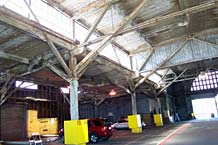
| Interior, Pier 3, 2001, shed demolished 2004 |
 |
|
| Interior, Pier 26 |
 |
|
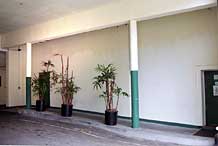
| Interior, Pier 38, 2004, gentrification begins |